
Strengthening the Future of Athens Special Events
Free-to-attend events are the heartbeat of Athens’ identity and a primary driver of our local economic ecosystem.
The following pages present a structured overview of Athens-Clarke County’s special events funding landscape — including how events are currently supported, the gap between that support and actual operating costs, and a specific set of policy recommendations for the commission’s consideration. Each section is intended to be reviewed in order.
This report is presented in four sections. Please review each tab in order or use the “NEXT” button at the bottom of each page to navigate.
Athens Runs on Its Events
Free, community-rooted, and economically vital
Special events are not simply entertainment. They are essential infrastructure—but more than that, they are the culture, soul, and identity of Athens. They are the heartbeat of our creative economy and the primary way we share our city’s spirit with the world.
A Homegrown Legacy
Downtown Athens is home to some of Georgia’s most beloved free public events: AthFest, the Twilight Criterium, Wild Rumpus, and many others. Unlike commercial festivals managed by outside promoters, these are homegrown traditions. They are locally organized, free to attend, and family-friendly. They serve as our city’s most authentic cultural calling card, acting as a powerful engine for tourism that showcases Athens as a world-class destination for the arts.
Economic Impact Without Barriers
Our events bring hundreds of thousands of people into the heart of our city. They fill hotel rooms, drive foot traffic to brick-and-mortar storefronts, and put money directly into the hands of local musicians, artists, and food vendors. Most importantly, they provide these benefits without charging a single admission fee, ensuring that the best of Athens remains accessible to every member of our community.
The Cost of Excellence
These landmarks of Athens life are made possible by dedicated organizers, tireless volunteers, and community stakeholders who keep them running year after year—often absorbing personal costs to ensure the gates stay open and the lights stay on.
Investing in Our Future
As our city grows and the costs of production, security, and infrastructure continue to rise, the traditional model of “getting by” is no longer sustainable. To preserve the unique character of our community, a renewed and proportional investment from the city is essential. Supporting these events is not a subsidy; it is a direct investment in the continued economic and cultural prosperity of Athens.
Hotel/Motel Funding and Athens Events
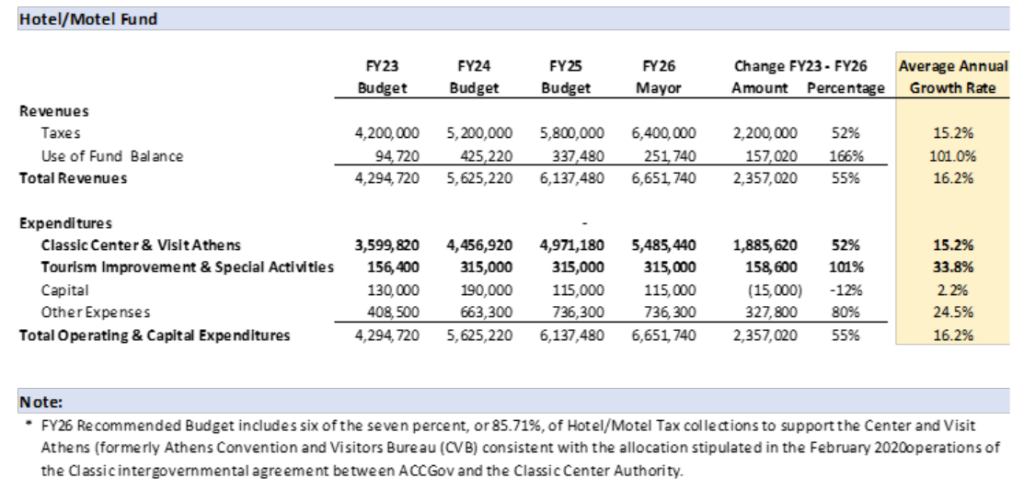
The Mayor and Commission approves a budget to fund special events in Downtown Athens through the Athens Downtown Development Authority (ADDA). It’s called the Community Enhancement Program (CEP). Special events like Athfest and Twilight receive their city support through CEP. Money for the CEP comes from the Hotel/Motel Fund.
Here’s the current breakdown:
- Total Hotel/Motel Fund: ~$6.4 million (FY 2026)
- CEP allocation to Special Events: $250,000
- That’s less than 4% of the fund
DEEPER DIVE: How is this calculated?
While the State of Georgia establishes the legal framework for Hotel/Motel tax, Athens-Clarke County applies additional local ordinances to govern how that revenue is actually distributed. Specifically, they decide on allocations to the following:
- Athens-Clarke County general fund
- The Classic Center Authority
- Visit Athens (the Convention & Visitors Bureau)
This is typically done by separate resolution or intergovernmental agreement attached to a budget or commission action, not directly within the tax-imposing ordinance itself.
For example, a commission resolution from January 6, 2021 clearly spells out how the proceeds should be distributed while certain Classic Center debt remains outstanding. The language (from the County Commission agenda/minutes) states:
- 16.25 % (1.3 pennies) to Athens-Clarke County general fund
- 56.25 % (4.5 pennies) to The Classic Center Authority
- of which portions are designated for tourism promotion, tourism product development, and servicing arena debt
- 27.50 % (2.2 pennies) to Athens Convention & Visitors Bureau
- broken down further by state law categories
This resolution functions like a legislative allocation directive (which is allowed under authority statutes such as O.C.G.A. § 48-13-51), but it is distinct from the hotel-motel tax ordinance itself.
Policy & Budget References and Links
- State Framework: Georgia Code O.C.G.A. § 48-13-51 (The legal basis for Hotel/Motel tax)
- Local Allocation: ACC Commission Resolution (Jan 2021) (How Athens chooses to split the revenue)
- Current Budget: FY26 Approved Operating Budget (p. E-8) (The $6.4M H/M Fund total)
TO BE CLEAR: This isn’t general tax revenue. This is a tourism-designated fund, and special events are one of the primary reasons people visit Athens in the first place. The money exists. Thethe question is whether our local allocations should be updated to reflect the actual economic and cultural impact these events generate for our city.
The Problem: The Sustainability Gap
Special events are not private ventures — they are public infrastructure. Rising Operational Costs: Combined event budgets have climbed to over 1.5 million dollars, yet current ACC support remains stagnant at $250,000
Special events are not private ventures — they are public infrastructure:
- They require police, permitting, sanitation, and emergency services
- They are free and accessible to all residents
- They generate tourism, hotel stays, and downtown spending
- They directly employ local musicians, artists, vendors, technicians, and staff
As production costs rise, events are increasingly forced to:
- Rely on unpaid labor
- Underpay skilled staff
- Reduce programming or scale
- Seek sponsorships that compromise the character of the event
$100,000+
Paid back to city services (Police, Permits, staging, etc.).
$250,000
Current City Support (CEP).
$1.5 Million+
Combined Budgets of 10 Special Events
DEEPER DIVE: Comparable Cities
Explore how other benchmark cities successfully invest in their local events to drive long-term economic growth.
THE ASK
The Special Events Collective is asking the commission for two things:
[simple paragraph outline all of this and going to the recommendations page with a button at the bottom]
Increase annual CEP funding for Special Events The current $250,000 allocation has not kept pace with inflation or the real operational costs of running safe, professional, free public events. We are asking for an increase that reflects what it actually costs to produce these events at the level Athens expects and deserves.
Raise the individual event funding cap The current per-event cap limits what any single event can receive, making it impossible for larger events to cover even their mandatory city costs through CEP alone. Raising this cap allows events to pay skilled staff fairly, maintain safety standards, and reduce reliance on volunteer labor for professional roles.
Both of these changes represent a small shift in how an existing fund is allocated — not new spending. The Hotel/Motel Tax Fund generates over $6 million annually. Special events currently receive less than 4% of that. We are asking for a share that reflects their contribution to the tourism economy that fund was designed to support.
Athens’ free events bring people here. Those people fill hotel rooms. Those hotel rooms fund the CEP. The cycle works — but only if the investment is maintained.
To keep Athens’ flagship events viable, we are asking the Commission to increase total CEP funding and raise individual event caps. This is not a request for new tax revenue, but a strategic shift in how existing tourism funds are allocated to meet rising operational costs.
Is Athens Remaining Competitive?
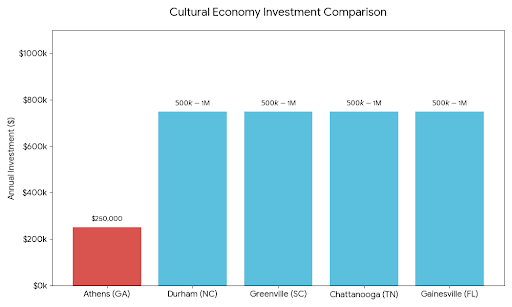
Cities like Durham (NC), Greeneville (SC), Chattanooga (TN) and Gainesville (FL) have made the investment. They are actively attracting the kind of cultural economy that Athens built first and now risks losing. This is a competitive landscape, and standing still is falling behind.
Special events don’t fail overnight. They shrink. A stage disappears. A beloved act can’t be booked. A paid coordinator role becomes a volunteer ask that eventually goes unfilled. The event still happens — but it’s a little less than it was. And then a little less again.
That’s the trajectory Athens is currently on.
When events can’t pay skilled technicians, sound engineers, and production staff fairly, those people leave for markets that will. When organizers can’t cover rising costs, they either seek outside sponsors — which can shift an event’s identity — or they step away entirely. Institutional knowledge built over decades walks out the door.
The community feels it before the commission ever sees a formal request. Attendance softens. Press coverage thins. The hotels that feed the very fund supporting these events see fewer bookings around event weekends.
Cities like Durham and Chattanooga have made the investment. They are actively attracting the kind of cultural economy that Athens built first and now risks losing. This is a competitive landscape, and standing still is falling behind.
View the results of our comparable cities research here. [button at bottom that links to this]